Edmonton's subsurface tells a story of ice and water. The retreat of the Laurentide Ice Sheet left behind a complex layering of dense till and, crucially, pockets of loose fluvial sands within the buried preglacial valleys. When infrastructure demands bearing capacity on these softer lenses—say a new bridge pier in the river valley—vibrocompaction design becomes the critical first step toward a stable foundation. The city's unique geotechnical challenge isn't just densifying a uniform loose layer; it's targeting specific 2- to 5-meter-thick sand seams sandwiched between hard clay till at depths of 6 to 15 meters. A solid vibrocompaction strategy here integrates CPT testing to map the exact boundaries of these weak zones before any vibrator hits the ground, ensuring the treatment grid actually addresses the problem and not the competent overburden.
In Edmonton, effective vibrocompaction isn't a brute-force operation—it's a surgical procedure targeting isolated loose sand lenses within a dense glacial till matrix.
Scope of work in Edmonton
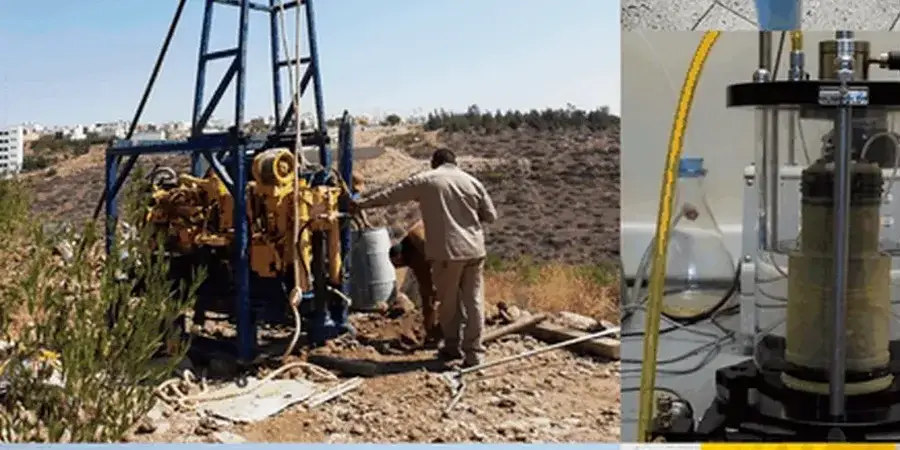
Field demonstration
Typical technical challenges in Edmonton
The NBCC 2020 assigns seismic design values to Edmonton that, while lower than the Pacific coast, interact critically with Site Class D profiles when loose sands are left untreated. A real-world scenario from the city’s industrial southeast saw a proposed tank farm settle differentially by over 120 mm during hydrotesting because a 3-meter loose sand layer at 9 meters depth was missed during a sparse preliminary investigation. The owner faced a year of delays and a six-figure remediation bill. The risk isn’t a sudden bearing failure—it’s a gradual, uneven settlement that racks steel connections and fractures rigid piping. Incorporating vibrocompaction design early in the geotechnical campaign, guided by ASTM D6066, mitigates this by transforming a potentially compressible lens into a uniform, high-stiffness mass. The key is recognizing that Edmonton’s stiff upper till can mask a soft bottom; a refusal-based termination criterion without depth-specific performance targets is the most common design pitfall we observe in local practice.
Our services
Our vibrocompaction design package for Edmonton projects is structured to move from desktop feasibility to field-ready specifications, always calibrated against the site's specific glacial depositional environment.
Treatment Feasibility and Grid Design
We analyze grain-size distributions and in-situ CPT data from the target sand layer to confirm compatibility with depth vibrator techniques. The deliverable includes an optimized triangular grid layout, probe diameter selection, and step-by-step compaction sequence for the site.
Performance Specification and Acceptance Criteria
We define a minimum post-treatment cone tip resistance (qc) profile based on the required bearing capacity or settlement limit. The specification sets clear hold points for trial zones and statistical acceptance ranges for production compaction, referencing ASTM D6066.
Construction Monitoring and Verification Protocol
We design the instrumentation and testing plan to confirm performance: pre- and post-compaction CPT pairs at every fourth probe location, real-time energy monitoring logs (amperage and vibration frequency), and a criterion for re-striking if refusal is met prematurely.
Questions and answers
What depth can vibrocompaction effectively treat in Edmonton's soil profile?
In Edmonton, the target depth is typically governed by the base of the preglacial sand and gravel channels, which often sit between 8 and 15 meters below ground surface. Below that, the competent bedrock or dense till provides a natural refusal layer. Our designs specify equipment with a vibrator length and follower tube assembly capable of reaching the full design depth without sacrificing energy transfer at the tip.
How is the vibrocompaction grid spacing determined for a site near the North Saskatchewan River?
Spacing is inversely proportional to the fines content and the target relative density. For river valley sands with 8–12% fines, we typically start with a 2.1-meter triangular grid in the trial zone. We then adjust based on the measured cone resistance increase after the trial probes—tightening to 1.8 meters if the post-CPT qc gain is under 60%, or opening to 2.4 meters if the improvement exceeds 100% with no excess pore pressure buildup.
What is the typical cost range for a vibrocompaction design package for an Edmonton industrial lot?
For a typical industrial development in Edmonton, the design package—including the feasibility assessment, grid optimization, trial program specification, and verification protocol—ranges from CA$2,130 to CA$7,160. The final figure depends on the site’s size, the number of CPT pairs required, and whether a supplementary geophysical cross-check is specified.
Can vibrocompaction mitigate frost heave in the overlying till layer?
No, vibrocompaction targets granular materials at depth and has no direct effect on the frost susceptibility of the near-surface clay till. Frost heave is a function of the fine-grained matrix’s pore structure and access to water, which vibrocompaction doesn’t alter. For frost protection, we specify a separate insulation strategy or a granular frost pad above the treated zone, per CSA A23.3 and local building code requirements.