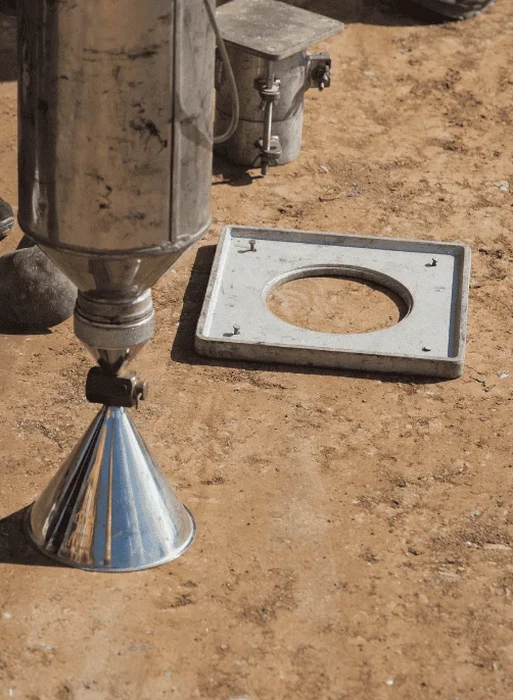
Edmonton sits on a complex glacial legacy — the city is underlain by up to 30 meters of till, glaciolacustrine clays, and outwash sands deposited by the Laurentide Ice Sheet. Those sediments behave differently under load depending on how they were placed. When a contractor backfills a sewer trench along 23rd Avenue or compacts the subgrade for a new warehouse in Acheson, the only way to know the job was done right is a field density test. We run the sand cone method because it gives a direct measurement of in-place density, no calibration factors, no assumptions about the soil matrix. The procedure follows ASTM D1556-15, and our lab is accredited under ISO 17025 for field density determinations. For jobs where the fill is too coarse or the access too tight, we pair the sand cone with a nuclear gauge correlation from our CPT rig to keep the QA/QC program moving without sacrificing accuracy.
The sand cone doesn't lie — it measures the hole you dig, the soil you pull out, and the sand that fills the void. That's three direct measurements with zero instrument drift.
Scope of work in Edmonton
Typical technical challenges in Edmonton
A townhouse foundation in Mill Woods started showing hairline cracks six months after occupancy. The builder had density records from a nuclear gauge, but the readings were taken on frozen fill in late November. When we re-tested the same lifts with the sand cone method in April, we found dry density values 8% below the specified 98% of Proctor — the fill had thawed, settled, and left voids under the footing. Edmonton's freeze-thaw cycles are brutal on poorly compacted fill. Clays heave in winter and slump in spring, and any lift placed on ice lenses or frozen lumps turns into a future settlement problem. The sand cone test, done right, forces the inspector to look at the soil coming out of the hole — its color, its moisture, whether it has frozen clods. That visual check is as valuable as the density number itself. When the spec says 95% modified Proctor and the soil is borderline, one sand cone test can save a season of headaches.
Our services
The field density test is part of a broader compaction control program. These are the two core services we deliver alongside every sand cone test in the Edmonton region.
Field Density Verification
On-site sand cone testing per ASTM D1556 for trench backfill, building pads, roadway subgrade, and utility bedding. We supply a signed field report with wet density, dry density, moisture content, and percent compaction against the lab Proctor curve. Our technicians carry calibrated sand, scales, and field ovens in the truck to deliver results before leaving the site.
Laboratory Moisture-Density Relationship
Standard and modified Proctor tests (ASTM D698 and D1557) on representative fill samples to establish the compaction target. We run the Proctor on the exact material coming out of the borrow pit or the trench excavation, so the field density numbers have a valid reference curve.
Questions and answers
What does a sand cone field density test cost in Edmonton?
A single sand cone test in the Edmonton area typically runs between CA$150 and CA$220, depending on the number of tests per mobilization and the travel distance. Most commercial compaction programs need 5 to 15 tests per day, and the unit price drops with volume. We quote per-test or per-half-day rates so you can budget the QA/QC line item accurately.
Can the sand cone test be done on gravelly fill or crushed concrete?
Yes, but with limits. The ASTM D1556 method works on soils with particle sizes up to about 19 mm. For fill with larger cobbles or recycled concrete, the hole walls tend to collapse and the sand cone volume becomes unreliable. In those cases, we recommend a test pit with a water-replacement density check or a calibrated nuclear gauge cross-checked against a sand cone on the finer portion of the fill.
How many sand cone tests does the City of Edmonton require for a typical building pad?
The City of Edmonton Design and Construction Standards generally require one field density test per lift per 500 square meters of building pad area, with a minimum of three tests per lift regardless of pad size. For utility trench backfill, the frequency increases to one test every 50 linear meters per lift. We coordinate with the city's materials testing inspectors to make sure the test locations and frequencies match the approved quality control plan.
How fast do we get the field density results?
Wet density and percent compaction are available on site within 20 minutes of completing the test, because we run the moisture content with a field oven or a calibrated Speedy meter. The formal signed PDF report leaves our office the same day, usually within 2 hours after the technician returns from the field. If the compaction fails, we flag it verbally before we pack up the equipment so the crew can re-compact immediately.