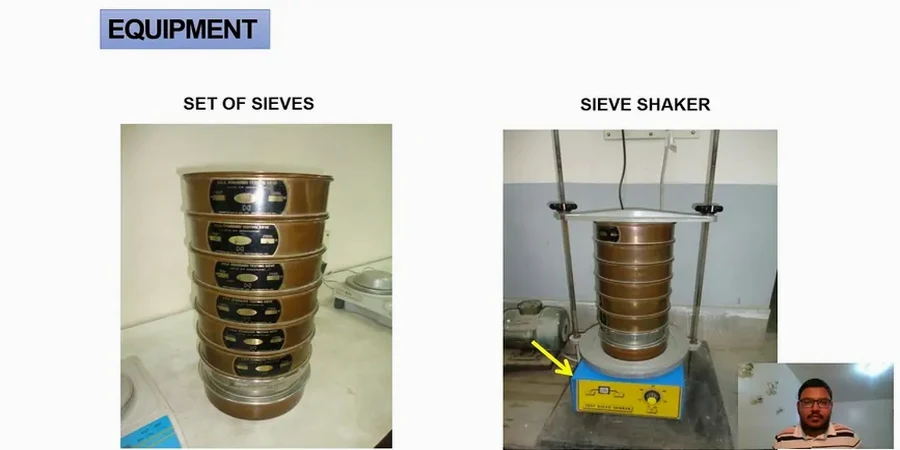
Edmonton sits on a complex glacial legacy where the North Saskatchewan River has carved through lacustrine clays, glacial till, and outwash sands. The grain size curve here rarely tells a simple story. We routinely see gap-graded mixtures where a hydrometer-only analysis would miss the sand fraction entirely, and sieve-only work would blind you to the silt-clay transition that governs frost action. That is precisely why our lab combines mechanical sieve stacks with hydrometer sedimentation in a single continuous distribution, following ASTM D422 for the full curve and ASTM D6913 when coarse fraction dominates. For contaminated sites along the river valley, we often pair this with in-situ permeability testing to correlate gradation with hydraulic conductivity, which matters enormously for infiltration trench design in the Bonnie Doon and Cloverdale neighborhoods where clay lenses control drainage.
A hydrometer curve that flattens after 24 hours tells you more about the clay mineralogy than a dozen Atterberg tests.
Scope of work in Edmonton
Typical technical challenges in Edmonton
The biggest geotechnical surprise in Edmonton comes from the Lake Edmonton clay, a preglacial lacustrine deposit that can contain 60 to 80 percent fines. When a grain size curve shows a flat slope across the silt range, you are likely dealing with a soil that will lose significant strength upon remolding. We see this pattern repeatedly in cores from the Belgravia and McKernan areas, where the clay fraction measured by hydrometer drops below 2 microns late in the sedimentation run, signaling a lean clay that still classifies as CH under USCS because of its high plasticity. Missing that transition is not a theoretical risk; it means the difference between a footing design that accounts for settlement-sensitive clay and one that assumes a more forgiving ML silt. For deep basement excavations near the river valley, we recommend running the full hydrometer analysis alongside a slope stability evaluation, because the fines content directly feeds the effective stress parameters used in the stability model.
Our services
Our Edmonton laboratory handles the full workflow from sample splitting to final report, and we tailor the analysis protocol to the soil type you actually have on site, not a generic template.
Combined sieve and hydrometer
Complete particle size distribution from 75 mm down to 1 µm in a single integrated curve, with automated data logging of hydrometer readings.
Washed sieve analysis
Separation of the minus No. 200 fraction by wet washing, essential for Edmonton tills where clay coatings on sand grains inflate the apparent fines content.
Hydrometer-only for clays
Full sedimentation run on samples passing the No. 200 sieve, with temperature correction and dispersant blank subtraction per ASTM D422.
Gradation for concrete aggregate
CSA A23.2-5A compliant sieve analysis for coarse and fine aggregates used in ready-mix and precast operations across the Edmonton metro area.
Questions and answers
What does a grain size analysis cost for a single sample in Edmonton?
For one sample processed through combined sieve and hydrometer, the cost runs between CA$160 and CA$230 depending on whether we need to wash the fines first and how many days the hydrometer run requires. Most Edmonton projects submit three to five samples per borehole to capture the vertical variability.
Why do Edmonton lacustrine clays need a hydrometer instead of just sieving?
Lake Edmonton clay typically has 60 to 80 percent passing the No. 200 sieve, so a sieve-only analysis would classify it simply as minus 75 microns without distinguishing silt from clay. The hydrometer sedimentation curve reveals the true clay fraction below 2 microns, which controls compressibility, swell potential, and long-term settlement behavior.
How long does the full hydrometer test take in your lab?
The standard hydrometer run requires readings at specified intervals over a minimum of 24 hours, with the final reading taken at 1440 minutes. We prepare the sample and set up the cylinders on day one, and the final report with the combined grain size curve is typically ready by the afternoon of day three.