Edmonton sits on a deep sequence of glacial Lake Edmonton sediments, predominantly stiff, high-plasticity clays that can heave more than 80 mm in a single winter. When we design a rigid pavement here, we are not just calculating slab thickness—we are engineering a structural system that must survive 100+ freeze-thaw cycles per year, sulfate-rich soils, and a frost penetration depth that regularly exceeds 2.4 meters. The city’s road network, from the Anthony Henday Drive to industrial yards in Nisku, demands concrete pavements that resist curling stresses and subgrade volume changes simultaneously. Our approach integrates subgrade stabilization with the CBR testing protocol to establish a resilient working platform, and we rely on in-situ permeability tests to quantify drainage characteristics before selecting a joint spacing layout that minimizes mid-panel cracking under Alberta’s extreme thermal gradients.
A rigid pavement in Edmonton is a structural slab engineered to bridge seasonal volume changes in glacial clay while carrying industrial axle loads.
Scope of work in Edmonton
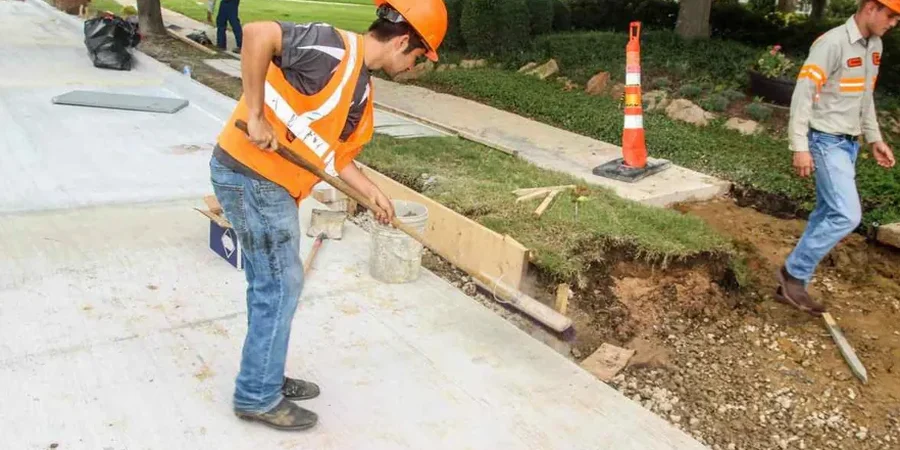
Field demonstration
Typical technical challenges in Edmonton
Edmonton’s expansion during the post-war oil boom pushed development onto lacustrine plain soils that had never supported heavy infrastructure before. Early rigid pavements in neighborhoods like Calder and Inglewood suffered premature joint faulting and corner breaks because the subgrade’s extreme volume change was underestimated. Today, the primary failure modes we mitigate are pumping-induced erosion beneath slab corners—exacerbated by spring thaw saturation—and longitudinal cracking caused by curling stresses in wide slabs. Sulfate attack on the concrete matrix remains a persistent risk in east Edmonton, particularly near former industrial lands, where groundwater chemistry can degrade untreated cement paste within a decade. A design that skips a thorough subgrade investigation or misjudges the frost-susceptibility classification will require slab replacement far sooner than the 30-year service life our clients expect.
Our services
Our rigid pavement engineering in the Edmonton capital region covers the full design life cycle, from subgrade evaluation to joint detailing and construction QA/QC support. We tailor each scope to the site’s specific clay plasticity, drainage regime, and loading requirements.
Thickness design and joint layout
We develop slab thickness solutions using ACPA and PCA methods, calibrated to the subgrade k-value and ESAL projections. Joint plans account for thermal movement, load transfer efficiency, and long-term maintenance access.
Concrete mix validation and durability testing
Our laboratory performs flexural strength, freeze-thaw resistance (ASTM C666), and sulfate resistance testing on trial mixes to confirm compliance with City of Edmonton supplemental specifications and CSA A23.1 exposure class requirements.
Questions and answers
What is the typical cost range for a rigid pavement design in Edmonton?
How does Edmonton’s freeze-thaw cycle affect joint performance in concrete pavements?
With over 100 freeze-thaw cycles annually, joints must accommodate slab expansion and contraction while preventing water infiltration. We specify sealed, doweled contraction joints at 3.5 to 4.5 m intervals and use non-extruding, low-modulus sealants that remain flexible at -40°C to avoid sealant pull-out during winter contraction.
Which subgrade parameters are most critical for rigid pavement design on Edmonton’s glacial clays?
The modulus of subgrade reaction (k-value) is the primary input for slab thickness calculation, and we derive it from plate load tests or CBR correlations on the high-plasticity Lake Edmonton clay. Equally important are the soil’s sulfate content, frost susceptibility classification, and the long-term groundwater position—all of which influence base course design and concrete mix specification.