Edmonton sits on the boundary between parkland and prairie, where lacustrine clays and glacial tills dominate the subsurface. Winter temperatures routinely drop below -30 °C and frost penetration reaches 2.2 m in open areas, so flexible pavement design here cannot simply follow a generic catalogue. The combination of high-plasticity Lake Edmonton clay, seasonal heave, and spring thaw weakening demands a granular structure that stays resilient through dozens of freeze-thaw cycles each year. Our team builds pavement sections around the AASHTO 93 empirical method, calibrated with local CBR values obtained under soaked conditions that replicate the worst week of breakup. Before finalizing the asphalt thickness, we often correlate the subgrade response with an in-situ permeability test to confirm drainage capacity below the frost line and with a CBR road assessment to anchor the structural number to actual field strength rather than textbook tables.
A flexible pavement in Edmonton lives or dies by its base course drainage: if water can’t escape before freeze-up, the section will fail in three seasons.
Scope of work in Edmonton
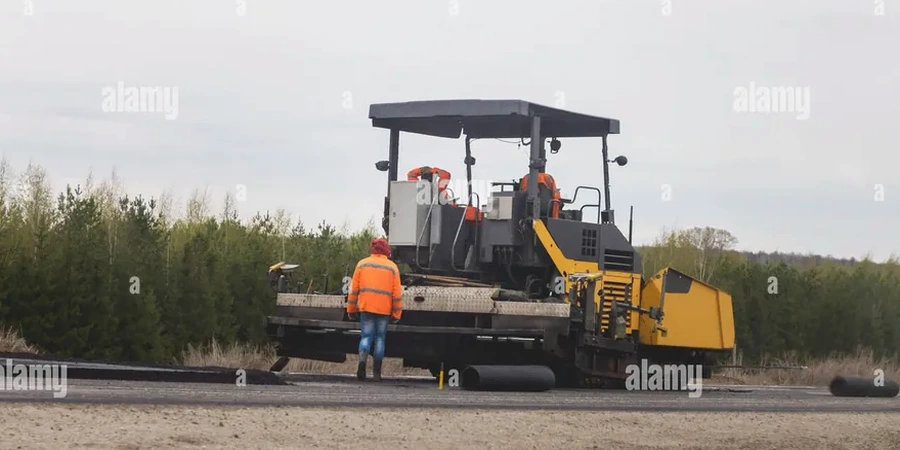
Typical technical challenges in Edmonton
Alberta Transportation specifications mandate that flexible pavement design account for the full depth of frost penetration, because ice lens formation in Edmonton’s silty clay subgrades can lift a road by 40–80 mm over a single winter. When the thaw front moves downward in April, trapped meltwater saturates the upper subgrade and reduces its bearing capacity to less than half the summer value. If the granular base is too thin or the drainage detail is omitted, the asphalt layer fatigues rapidly under traffic, producing alligator cracking within the first two years of service. A pavement section that ignores the local frost-susceptibility classification is not a cost saving; it is a guaranteed maintenance liability. Our designs always include a non-frost-susceptible capping layer and, where the water table is high, a subdrain system that outlets to a positive drain. We verify the design assumptions with post-construction falling weight deflectometer testing to confirm that the back-calculated moduli meet the seasonal adjustment factors published by the City of Edmonton.
Our services
Our Edmonton flexible pavement design service covers everything from subgrade investigation through to pavement structure optimization. Each deliverable is signed by a professional engineer registered with APEGA and backed by our ISO 17025-accredited soil mechanics laboratory.
Subgrade evaluation and CBR program
We drill boreholes to 3 m depth, extract Shelby tubes, and run soaked CBR tests at the expected post-thaw moisture content. The program includes Atterberg limits, grain-size distribution, and Proctor compaction to establish the moisture-density relationship used for construction QA/QC.
Pavement structure optimization
Using the AASHTO 93 equation and local ESAL forecasts, we iterate the layer thicknesses to minimize granular import while meeting the required structural number. We provide a detailed pavement design report with cross-sections, drainage details, and a construction specification package aligned with City of Edmonton and Alberta Transportation standards.
Questions and answers
What is the typical flexible pavement section for a residential street in Edmonton?
A standard local residential street in Edmonton usually consists of 50 mm of hot-mix asphalt over 150 mm of crushed aggregate base course (CBR ≥ 80) and 300 mm of select granular sub-base, placed on a compacted clay subgrade. The exact thicknesses depend on the subgrade CBR, which we measure in the lab under soaked conditions. Streets expected to carry bus routes or waste-collection trucks receive an additional 25–40 mm of asphalt.
How do freeze-thaw cycles affect flexible pavement in Edmonton?
Freeze-thaw cycling is the dominant distress mechanism in Edmonton. During freezing, ice lenses form in the subgrade and heave the pavement unevenly. When the thaw front descends in spring, meltwater becomes trapped between the frozen layer below and the pavement above, saturating the base and drastically reducing its modulus. A properly designed granular layer, non-frost-susceptible capping material, and positive drainage prevent this saturation from causing structural failure.
What is the cost range for flexible pavement design in Edmonton?
For a typical flexible pavement design package covering subgrade investigation, laboratory CBR testing, and pavement structure optimization, the fee ranges from CA$1,980 to CA$7,350 depending on the length of roadway, number of boreholes, and traffic loading complexity. A detailed proposal is provided after reviewing the site plan.
What laboratory tests are required for Edmonton pavement design?
The essential laboratory program includes: moisture content and density (ASTM D2216), Atterberg limits (ASTM D4318), grain-size analysis (ASTM D422/D6913), modified Proctor compaction (ASTM D1557), and soaked CBR (ASTM D1883). In areas with saline soils, we add soluble-sulphate testing. For high-traffic arterials, we also run resilient modulus or repeated-load triaxial tests to calibrate the AASHTO structural layer coefficients.