Edmonton sits on a complex legacy of glacial Lake Edmonton sediments and preglacial buried valleys, which means the near-surface stratigraphy can shift from stiff till to compressible lacustrine clay within a single city block. The Victoria Valley and buried preglacial channels concentrate soft deposits where conventional shallow footings become impractical. For those conditions, stone column design offers a ground improvement path that transfers structural loads past the weak zone into the competent till or bedrock beneath. The design process integrates site-specific CPT data with CPT test profiles and grain-size distributions from grain size analysis to select the right aggregate gradation and column spacing. In the Edmonton region, the seasonal frost penetration, typically reaching 1.8 meters, adds a serviceability check that influences the top-of-column embedment and the granular mattress specification.
Stone column design in Edmonton is fundamentally about bridging soft glaciolacustrine pockets to reach competent till without preloading delays.
Scope of work in Edmonton
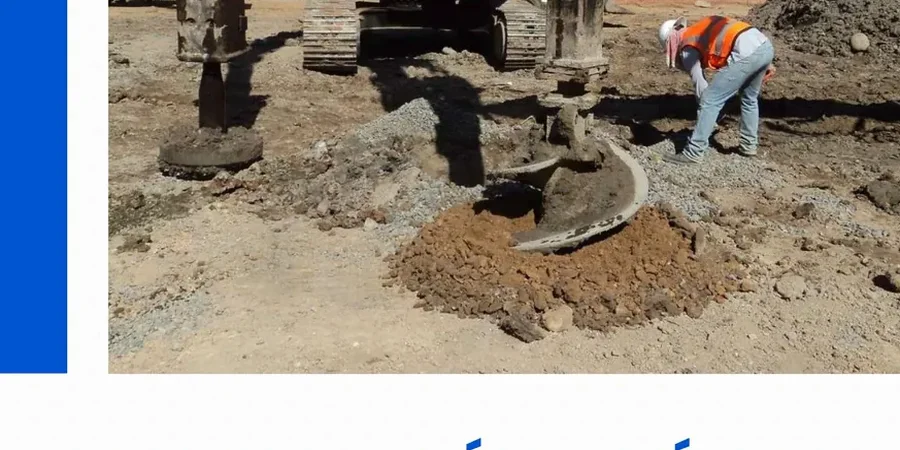
Typical technical challenges in Edmonton
Edmonton's expansion during the 1970s and 1980s pushed residential and commercial development into the low-lying areas near the North Saskatchewan River, where post-glacial clay and organic silt layers were left in place. Many older industrial lots in the Clover Bar area were built over buried sloughs, and today's redevelopment projects uncover compressible fill that standard strip footings cannot handle. The primary geotechnical risk is differential settlement between stone-column-treated zones and adjacent untreated ground, especially where the clay thickness varies sharply over short distances. A secondary concern is stone column bulging in the upper 2 to 3 meters if the confining stress from the surrounding soil is too low. In Edmonton's moderate seismic setting, the design also checks liquefaction potential in loose sand lenses interspersed within the glacial sequence, using SPT-based triggering correlations from the NCEER workshop recommendations.
Our services
The ground improvement scope in Edmonton typically includes three interconnected phases that move from subsurface characterization to field execution and verification.
Vibro-Replacement Feasibility Study
We compile CPT, SPT, and grain size data from your Edmonton site to evaluate whether stone columns are technically suitable. The study includes a settlement analysis comparing untreated and treated conditions using Priebe's method and a preliminary column layout.
Detailed Stone Column Design Package
The package delivers the column diameter, depth, grid spacing, aggregate specification, and granular mattress thickness calibrated to your structural loads. We provide installation acceptance criteria based on amperage and aggregate consumption records.
Post-Treatment Verification Testing
After installation, we perform plate load tests on individual columns and composite ground, along with geophysical cross-hole surveys to confirm column continuity. All results are benchmarked against the NBCC 2020 serviceability limits for total and differential settlement.
Questions and answers
What does stone column design cost for a typical Edmonton commercial lot?
How do Edmonton's cold winters affect stone column performance?
Frost penetration in Edmonton reaches about 1.8 meters, so the granular mattress above the stone columns must extend below the frost line or incorporate insulation. We design the upper portion of the column with a slightly reduced aggregate void ratio to minimize frost heave potential, and the column head is detailed to transfer loads without relying on frozen soil strength.
Can stone columns be installed close to existing buildings in Edmonton?
Yes, but vibration monitoring becomes essential. We set vibration limits based on the age and condition of adjacent structures, often referencing CSA S832 guidelines. In tight downtown Edmonton sites, we may specify a top-feed method with reduced vibroflot energy during the first few meters or switch to a displacement column technique if the clearance is under 2 meters.