Edmonton sits at an elevation of 645 meters above sea level, built on a complex sequence of glacial till, lacustrine clays, and preglacial sand and gravel channels carved by the North Saskatchewan River. That subsurface variety means a standard soil mechanics study here never follows a single template. One site near the river valley can hit dense till at two meters, while a lot three blocks east in the former Glacial Lake Edmonton basin might encounter ten meters of soft, compressible clay before reaching competent bearing strata. The city's rapid growth, with over a million people now calling the metro area home, pushes development onto marginal land where understanding soil behavior under load is not optional. A proper investigation sequences field sampling with laboratory testing to determine shear strength, consolidation potential, and stiffness parameters that directly control footing size, excavation support, and long-term settlement performance. When clay layers dominate, we often pair the study with triaxial testing to capture undrained strength under realistic confining pressures, and in sandy channel deposits we recommend liquefaction screening following the Youd-Idriss framework to satisfy NBCC seismic requirements.
Edmonton's glacial lake clays can lose half their shear strength when disturbed. The difference between a Shelby tube sample and a washed-out split spoon is the difference between an accurate settlement forecast and a surprise.
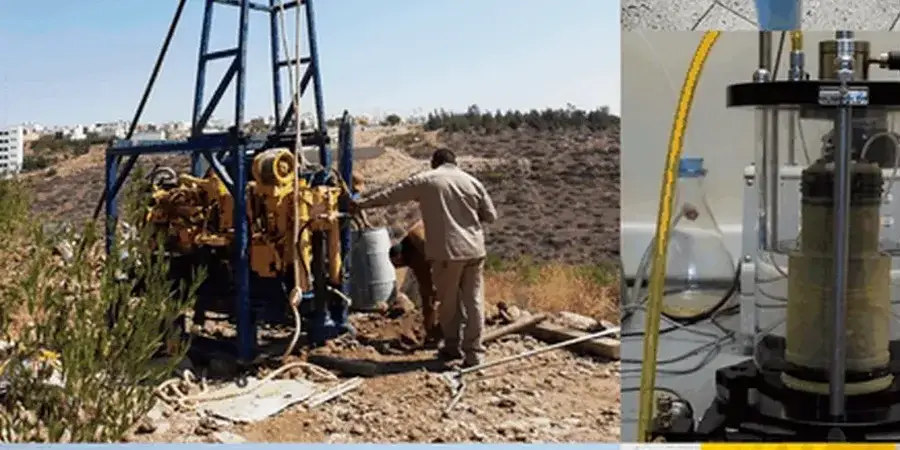
Scope of work in Edmonton
Typical technical challenges in Edmonton
A five-story residential project on 124 Street encountered a buried preglacial channel filled with loose sand at 11 meters depth, directly beneath the planned pile tip elevation. The original soil mechanics study had terminated borings at 10 meters, missing the channel entirely. When the contractor drove the first test pile, it punched through the till and free-fell two meters into the sand, triggering a rapid design revision that added eight meters to every pile length and delayed the project by six weeks. That case is not rare in Edmonton, where buried valleys carved into the bedrock surface can be 30 meters deep and filled with material far weaker than the surrounding till. Liquefaction potential in these channels under the design earthquake, assessed using SPT-based triggering correlations per NCEER and Seed-Idriss, often governs the foundation solution. For excavations deeper than 6 meters in the river valley, the slope-stability analysis must account for pore pressure buildup in clay interbeds that daylight on the cut face, a failure mechanism documented in several local landslides.
Our services
Every soil mechanics study we deliver in Edmonton is structured to answer the three questions that drive foundation cost: how strong is the soil, how much will it settle, and how does water affect both answers. The investigation scope adapts to project scale, from single-family homes on shallow spread footings to mid-rise towers on deep pile groups.
Field Investigation and Sampling
Truck-mounted drill rigs access tight urban lots across Edmonton's mature neighborhoods. Continuous sampling through overburden, with SPT at 1.5-meter intervals and Shelby tubes in cohesive layers, captures the stratigraphic detail needed for settlement-sensitive designs. Monitoring well installation tracks seasonal groundwater fluctuation in river valley and terrace deposits.
Laboratory Testing Program
Moisture content, density, grain size, Atterberg limits, unconfined compression, consolidation, and triaxial shear. Our lab follows ASTM and CSA procedures, with quality control under ISO 17025 accreditation. Results feed directly into bearing capacity, settlement, and lateral earth pressure calculations for the geotechnical report.
Questions and answers
How deep should a soil mechanics study go for a mid-rise building in Edmonton?
Borehole depth depends on the foundation type and the subsurface conditions encountered. For a mid-rise on piles, we typically advance borings to at least three pile diameters below the anticipated tip elevation, and deeper if weak layers are suspected. In Edmonton's glacial till, that often means 20 to 30 meters. The NBCC requires exploration to extend below any stratum that could cause excessive settlement.
What is the typical cost of a soil mechanics study in Edmonton?
How do Edmonton's glacial lake clays affect foundation design?
The glaciolacustrine clays deposited in the former Glacial Lake Edmonton basin are normally consolidated to lightly overconsolidated near the surface, meaning they are compressible and settlement can be significant under load. They also lose strength when remolded, so careful sampling is critical. Foundation solutions often involve extending footings or piles through the clay to the underlying till, or designing for controlled settlement with a rigorous monitoring program during construction.
Does a soil mechanics study include a slope stability assessment for river valley sites?
It can, and for any project near the North Saskatchewan River valley or its tributary ravines, it should. The study scope can be expanded to include slope stability analysis under both static and seismic conditions. We evaluate the factor of safety for rotational and translational failure surfaces, considering pore pressure from groundwater and the softening effect of the clay seams that are common in Edmonton's Cretaceous bedrock and overlying till.