A 35-meter excavation through stiff glacial till in downtown Edmonton is not the same as one on the river flats. We recently reviewed a project on Jasper Avenue where an adjacent 1960s building had spread footings at just 2.5 meters depth. The design had to limit lateral displacement to under 10 mm. That meant moving from a conventional soldier pile wall to a stiff secant pile system with post-tensioned anchors. For deep basements and LRT station boxes in Edmonton, groundwater control is often the controlling factor. The till matrix can hold perched water tables that surprise even experienced contractors. We combine in-situ testing like CPT testing with lab triaxial data to model drained and undrained behavior before selecting shoring types. In the river valley, where bedrock is shallower, the approach shifts toward rock socketing and drainage planes rather than soil nailing.
Edmonton till can stand unsupported for hours — until a sand lens saturates. That is when the real design challenge begins.
Scope of work in Edmonton
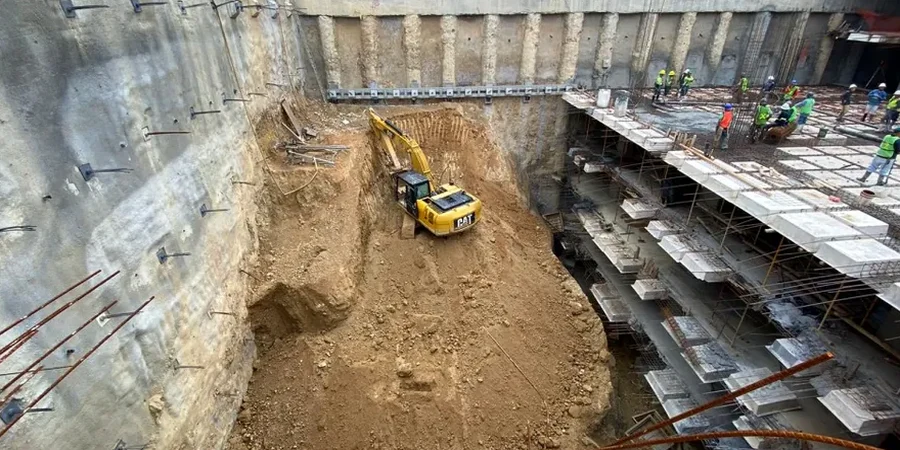
Typical technical challenges in Edmonton
Edmonton's deep excavation history carries lessons. The 1980s downtown boom pushed basements into the till with limited monitoring, and a few near-misses — wall deflections exceeding 50 mm, adjacent settlement — drove the adoption of stricter observational methods. The city's current geotechnical review process, aligned with NBCC 2020 and CSA A23.3, demands instrumentation plans for any excavation deeper than 6 meters within 10 meters of a property line. The biggest risk is not the till failing. It is the combination of overconsolidated clay behavior, perched water in sand stringers, and time-dependent shale swelling. A design that looks safe on paper can underperform if the construction sequence is not staged to control pore pressure dissipation. We specify staged excavation lifts, limit open-cut stand-up time, and require real-time inclinometer readings against predefined threshold values — typically 25 mm at mid-height of the wall as an alert level, 40 mm as action level.
Our services
Deep excavation design in Edmonton requires integration of geotechnical investigation, structural shoring design, and hydrogeological assessment. Each project starts with a factual ground model, not generic assumptions.
Shoring Wall Design
Secant pile, soldier pile, diaphragm wall, and soil nail wall design for cuts from 6 m to 35 m depth. Earth pressure diagrams calibrated to Edmonton till and shale properties.
Tieback Anchor Design
Post-tensioned and passive anchors designed per FHWA GEC No. 4. Bond length verification in till and shale, with sacrificial anchor testing on critical projects.
Base Stability & Heave Analysis
Terzaghi and Bjerrum-Eide methods for clay. 3D finite element modeling for complex excavations near existing foundations or LRT tunnels.
Construction Monitoring Plans
Instrumentation layout, threshold values, and contingency triggers. Inclinometer arrays, vibrating wire piezometers, and automated total station monitoring.
Questions and answers
What are typical shoring solutions for deep excavations in Edmonton's glacial till?
Soldier pile and lagging walls with tieback anchors are common for 10-18 meter cuts where groundwater is manageable. For deeper excavations or sites close to sensitive structures, secant pile walls or diaphragm walls provide greater stiffness and water cutoff. In the river valley, where bedrock is shallow, rock socketed soldier piles with drainage collectors often prove more economical than full-depth concrete walls.
How do you handle the swelling clay shale during excavation design?
We incorporate swelling pressure data from laboratory tests — typically 150 to 400 kPa for the Edmonton Formation — into the lateral earth pressure envelope. Construction specifications require immediate shotcrete or lagging placement after each lift to limit moisture ingress. In critical areas, we specify a compressible layer behind the permanent wall to accommodate long-term swelling without transferring excessive pressure to the structure.
What groundwater challenges affect deep excavations in Edmonton?
The main challenge is perched groundwater within sand lenses and silt seams in the till. These can produce sudden inflows during excavation that destabilize the face. We require pre-construction pumping tests and in-situ permeability measurements. Dewatering systems often combine deep wells for the basal aquifer with vacuum-assisted well points for the perched zones. A base plug or cutoff wall may be necessary when drawdown would cause settlement outside the site.
How much does geotechnical design for a deep excavation cost in Edmonton?
What monitoring is required during a deep excavation in Edmonton?
For excavations deeper than 6 meters near property lines, the City of Edmonton typically requires inclinometers in the shoring wall, survey prisms on adjacent structures, and piezometers to track groundwater levels. We define alert and action thresholds — commonly 25 mm and 40 mm of lateral deflection — and prepare contingency plans that may include additional tiebacks, berms, or revised excavation sequencing if readings approach those limits.