Edmonton's expansion from a fur-trading post into Alberta's capital demanded infrastructure that could withstand the region's punishing freeze-thaw cycles. The North Saskatchewan River valley carved through the city, leaving behind a complex legacy of glacial Lake Edmonton sediments, glaciolacustrine clays, and till deposits that challenge every pavement design. When the City of Edmonton updated its pavement design guidelines to reflect the realities of the local subgrade, the California Bearing Ratio test became the backbone of road structural design, linking laboratory-soaked strength to the long-term performance of flexible and rigid pavements alike. Our laboratory CBR testing provides the soaked and unsoaked penetration resistance values that consulting engineers need to determine pavement layer thicknesses under the City of Edmonton Design and Construction Standards, ensuring that arterial roads like Gateway Boulevard and residential collector streets both hold up under traffic loading and seasonal ground movement. For projects near the river valley where moisture-sensitive clays dominate, we often recommend pairing the CBR with a grain-size analysis to confirm the fines content that drives swelling potential during spring thaw conditions.
A soaked CBR of 3% on Edmonton glaciolacustrine clay can require double the granular base thickness compared to a well-draining till at 8% — the difference in a project's aggregate budget is significant.
Scope of work in Edmonton
Typical technical challenges in Edmonton
Edmonton's continental climate produces a frost penetration depth reaching 2.4 meters, driving ice lens formation in the fine-grained lacustrine clays that blanket much of the city's north and west sectors. When a pavement design relies on unsoaked CBR values or field tests conducted in August during dry conditions, the structural section will be dangerously undersized for the saturated subgrade conditions that prevail from April through June. The 96-hour soaked CBR test accounts for this seasonal weakening, but the result is only as reliable as the sample preparation. If the specimen is compacted at a moisture content that does not match the field density specification, or if the surcharge weight is incorrectly applied during soaking, the reported CBR can overestimate the true bearing capacity by 30% or more. For projects in the Clover Bar area where the glacial stratigraphy shifts rapidly between till and lacustrine deposits within a few hundred meters, a single composite CBR value can mask the variability that leads to differential frost heave and premature cracking. The laboratory CBR must be paired with a thorough geotechnical investigation that identifies the spatial extent of each subgrade unit across the alignment.
Our services
Our Edmonton laboratory supports pavement design projects with CBR testing and complementary geotechnical services tailored to the capital region's subgrade conditions.
Soaked Laboratory CBR with Swell Measurement
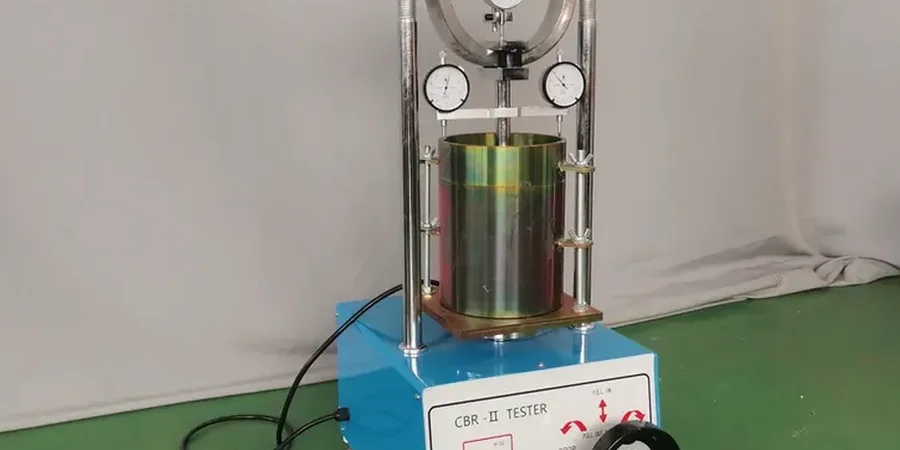
Full ASTM D1883 procedure with 96-hour soaking under surcharge. We compact specimens at your specified density and moisture target, measure the swell percentage during saturation, and report CBR values at both standard penetration depths. A single-point test requires approximately 25 kg of material passing the 19 mm sieve.
CBR-Based Pavement Thickness Design Support
We provide the soaked CBR input value for the AASHTO 1993 structural number equation, with recommendations for granular base course and sub-base thicknesses based on the City of Edmonton's minimum structural requirements for local, collector, and arterial road classifications.
Questions and answers
What is the difference between laboratory CBR and field CBR for Edmonton projects?
The laboratory CBR (ASTM D1883) tests a remolded specimen compacted at a controlled moisture and density and soaked for 96 hours, giving a conservative worst-case value for pavement design. Field CBR (ASTM D4429) measures the in-situ subgrade strength at its natural moisture content on the day of testing. In Edmonton, field CBR values measured in late summer can be 3 to 5 times higher than soaked laboratory values on the same clay, which is why the City requires the laboratory value as the design input. The field test is useful for construction verification but should not replace the laboratory value for structural design.
How much material do you need for a laboratory CBR test?
We require approximately 25 kg of representative soil passing the 19 mm (3/4 inch) sieve for a single-point CBR test. For projects with variable subgrade conditions, we recommend submitting separate samples from each distinct soil unit encountered in the test pits or boreholes. The material should be sealed in plastic bags immediately after excavation to preserve the natural moisture content if we are to replicate field conditions.
What is the typical cost of a laboratory CBR test in Edmonton?
How long does it take to get CBR test results back?
The standard turnaround is 5 business days from sample delivery, accounting for the 96-hour soaking period plus specimen preparation, compaction, and penetration testing. We can provide preliminary unsoaked CBR results within 2 business days for projects on tight schedules, with the final soaked value following after the saturation period is complete.