Edmonton's development from a fur trading post into a major metropolitan hub rested on a foundation of complex glacial geology. The city sits atop the Edmonton Formation, a sequence of Upper Cretaceous sandstones and shales overlain by thick Quaternary glacial till and glaciolacustrine clays, which control excavation behavior and long-term settlement. When these fine-grained soils are encountered on a project, their consistency and volume-change potential must be quantified before any design proceeds. Our laboratory provides Atterberg limits testing under ASTM D4318 to establish the liquid limit, plastic limit, and plasticity index, giving engineers the index properties needed for classifying soils within the USCS framework. This data feeds directly into foundation capacity estimates, slope stability models, and earthwork specifications for everything from residential subdivisions in Windermere to industrial pads in Acheson. We complement the classification work with grain-size analysis when the fines fraction requires further breakdown, and we run Proctor compaction tests on the same samples to link plasticity to moisture-density behavior for quality control during construction.
Plasticity index values above 25 percent in Edmonton's glaciolacustrine clays signal high swell-shrink potential that must be addressed in foundation and pavement design.
Scope of work in Edmonton
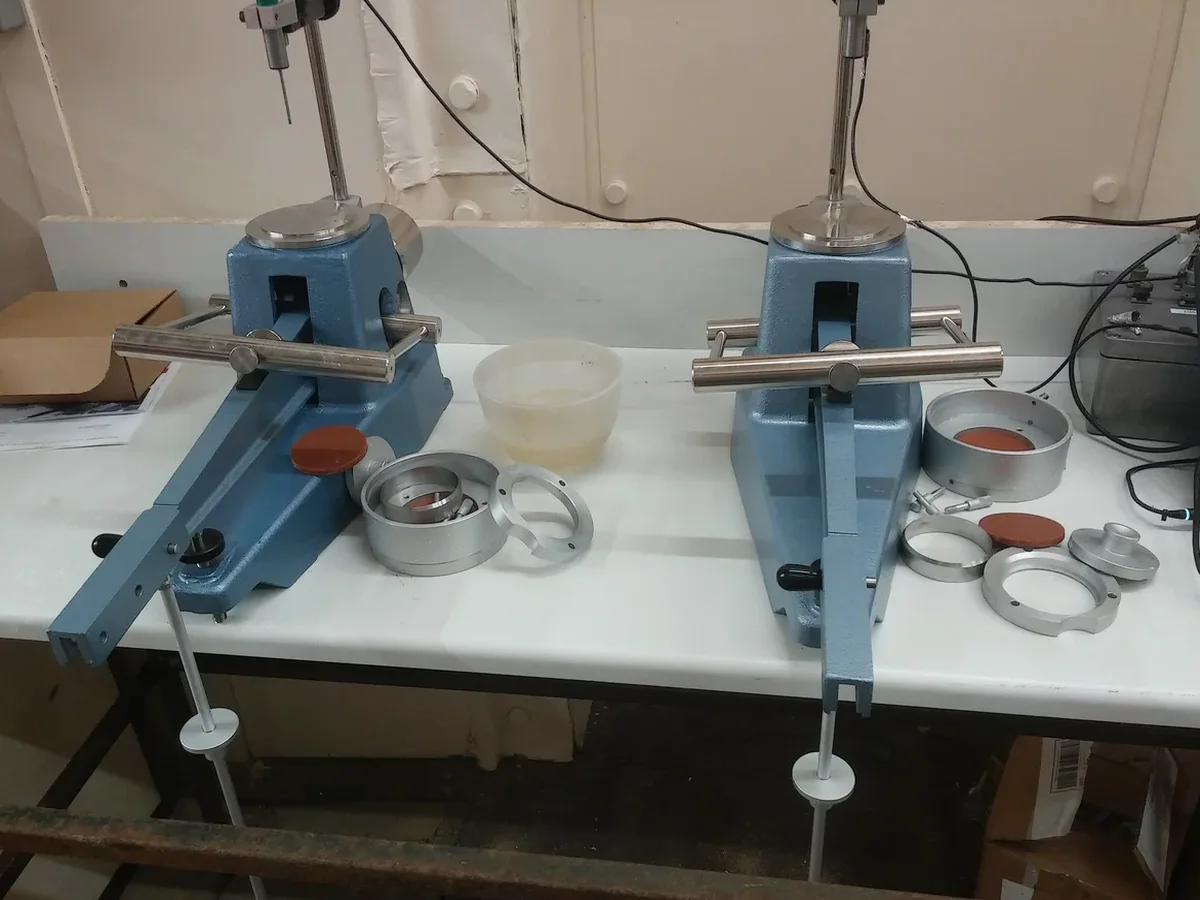
Typical technical challenges in Edmonton
The behavioral contrast between soils in Mill Woods and those in the west end near Lewis Farms illustrates exactly why Atterberg limits matter in Edmonton. Mill Woods sits on deep, soft glaciolacustrine silts and clays with liquid limits frequently exceeding 60 percent; these materials consolidate slowly under load and lose strength dramatically when saturated during spring thaw. Lewis Farms, by comparison, rests on stiffer glacial till with PI values often below 15 percent, where bearing capacity is higher but frost heave susceptibility remains a design concern. Skipping index testing on the high-plasticity deposits risks underestimating total settlement by 30 percent or more, while ignoring plasticity in granular tills can lead to mischaracterized drainage behavior and incorrect compaction specifications. The Atterberg limits test costs a fraction of the remedial work required when a foundation slab heaves or a utility trench collapses due to unaccounted volume change, and our ISO 17025-accredited laboratory delivers results within three business days to keep your project on schedule.
Our services
Our Edmonton geotechnical laboratory delivers Atterberg limits testing as part of a complete fine-grained soil characterization package. Each test is performed by a technician certified under our ISO 17025 quality system, and results are reported with chain-of-custody documentation suitable for regulatory submissions.
Standard Atterberg Limits (LL, PL, PI)
Complete determination of liquid limit, plastic limit, and plasticity index per ASTM D4318-17 on disturbed samples from auger cuttings, Shelby tubes, or test pit excavations across the Edmonton metropolitan region.
Shrinkage Limit and Shrinkage Ratio
Optional shrinkage limit testing per ASTM D4943 for high-plasticity clays where volume-change potential is critical, such as beneath lightly loaded spread footings or slab-on-grade foundations in swelling soil zones.
Questions and answers
How much does Atterberg limits testing cost in Edmonton?
How long does it take to get Atterberg limits results?
Our standard turnaround is three business days from sample receipt for a complete LL, PL, and PI report. Expedited 24-hour processing is available for urgent projects. The drying and sieving stages represent the longest steps, particularly for the high-moisture glaciolacustrine clays common in the Edmonton area.
What sample size is required for the test?
We need approximately 300 grams of material passing the No. 40 sieve. For Shelby tube or auger samples, a 100 mm long section of undisturbed material is usually sufficient. Samples should be sealed immediately after collection to preserve natural moisture content, especially during Edmonton's dry winter months when rapid desiccation can alter the plastic limit measurement.
Can Atterberg limits alone classify a soil for foundation design?
Atterberg limits provide the plasticity classification within the USCS system (CL, CH, MH, etc.), which is a critical first step, but foundation design also requires strength parameters. We typically pair Atterberg testing with unconfined compression or triaxial tests on the same soil unit to obtain the undrained shear strength and effective stress parameters needed for bearing capacity calculations in Edmonton's glacial deposits.