The National Building Code of Canada (NBCC 2020) and CSA A23.3 establish strict requirements for permanent and temporary earth retention systems. In Edmonton, where the subsurface shifts dramatically from stiff glacial till to Cretaceous clay shale and buried preglacial valleys, anchor design cannot rely on generic assumptions. A design that works in the west end's till may fail in the river valley's high-plasticity clays. The team integrates site-specific data such as CPT soundings to refine bond strength estimates and in-situ permeability tests to assess drainage behind the anchored wall, preventing hydrostatic build-up that compromises long-term performance. Every anchor we design accounts for freeze-thaw cycling, which penetrates up to 2.4 meters deep in this region and can degrade the grout-to-ground bond over successive winters if the bonded length is not placed below the active frost zone.
In Edmonton's clay shale, passive anchors often outperform active systems because they accommodate the slow, long-term deformation of the bedrock without losing bond capacity.
Scope of work in Edmonton
- Active anchors are post-tensioned to actively apply a design load to the structure, controlling lateral movement in deep excavations.
- Passive anchors are not stressed; they mobilize resistance only when the soil mass deforms, making them ideal for permanent tieback walls in swelling clay shales.
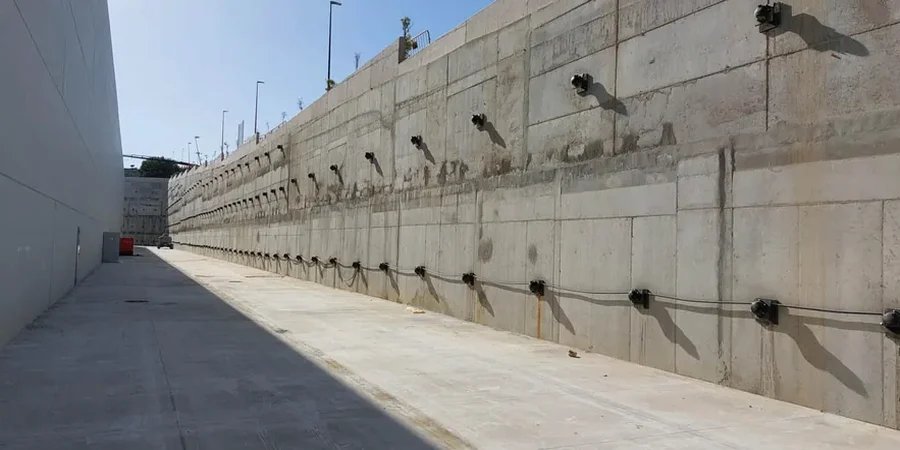
Typical technical challenges in Edmonton
Edmonton's expansion through the mid-20th century built extensively on the flat prairie uplands, but modern infill projects now push deeper into the river valley and ravine slopes. These slopes are underlain by the advance and retreat of glacial ice, leaving behind a chaotic stratigraphy of till, glaciolacustrine silt, and preglacial sand channels. Anchor designs that overlook a thin sand lens can experience sudden grout loss, with contractors losing hundreds of liters of grout into a hidden channel before realizing the problem. The anchor's capacity then becomes unpredictable because the bonded zone is incomplete. The team cross-references borehole logs with seismic refraction profiles to map these buried channels before anchor installation, reducing the risk of grout loss and ensuring the bonded length sits entirely within competent material. Creep in the Battle Formation clay shale remains the most insidious risk for pre-stressed anchors, as the shale can relax and shed load over years, transferring stress back to the wall facing.
Our services
Anchor design work in the Edmonton metro area spans multiple project types, from residential retaining walls in Mill Creek Ravine to commercial excavations in the Ice District. The following services cover the full lifecycle of an anchor installation.
Anchor Load Testing
On-site proof and performance tests per ASTM D3966, using a calibrated hydraulic jack and dial gauges to measure creep and elastic displacement over a 60-minute hold period.
Grout Mix Design Verification
Laboratory batching and triaxial testing of neat cement grouts to confirm workability, bleed, and compressive strength before field mixing begins in Edmonton's highly variable groundwater chemistry.
Bond Zone Capacity Analysis
Calculate ultimate bond stress from SPT N-values, undrained shear strength, or pressuremeter data, applying the FHWA GEC No. 4 methodology adapted for local till and shale.
Corrosion Protection Specification
Design of encapsulated tendon systems with factory-applied sheathing and heat-shrink field joints, tested for electrical isolation to meet the 100-year service life required for permanent Edmonton infrastructure.
Questions and answers
What is the difference between active and passive anchors in Edmonton's soil conditions?
Active anchors are tensioned during installation to immediately apply a restraining force, which is critical when excavation-induced movement must stay below 10 mm near adjacent buildings. Passive anchors are not stressed; they engage only when the soil mass begins to move. In Edmonton's high-plasticity Battle Formation shale, passive systems often reduce long-term maintenance because they avoid the stress relaxation that plagues pre-stressed tendons in creeping bedrock.
How much does anchor design and testing cost for a typical Edmonton project?
What is the typical bonded length for an anchor in Edmonton till?
Bonded lengths in dense glacial till commonly range from 4 to 9 meters, depending on the design load and the grouting method. Pressure-grouted anchors can achieve higher bond stresses, which sometimes allows a shorter bonded zone, but the minimum bonded length per CSA A23.3 must still be satisfied. Each design is verified with a sacrificial test anchor on site before production drilling begins.